> ## Documentation Index
> Fetch the complete documentation index at: https://docs.honeyhive.ai/llms.txt
> Use this file to discover all available pages before exploring further.
# Platform Architecture
> HoneyHive Platform Architecture (AWS)
This document describes the architecture for HoneyHive **hosted in AWS**.
Additional platform architecture documentation for **Azure**, **GCP, or on-prem implementations**, or our **Enterprise+ Federated** version (deployed in your own cloud environment with physically-separated data planes) is available upon request. Please contact your account executive or email [support@honeyhive.ai](mailto:support@honeyhive.ai) for more information.
## Overview
HoneyHive is a production-grade AI observability and evaluation platform built on enterprise-class infrastructure. Our architecture is designed to meet the stringent requirements of enterprise customers including security, compliance, scalability, and reliability.
The platform consists of three core components:
1. **Log Ingestion & Enrichment Pipeline** - Real-time event processing with zero data loss
2. **Evaluation & Analysis Engine** - Asynchronous job processing for offline evaluations
3. **Web Application & API** - User-facing interfaces and programmatic access
## Network Architecture
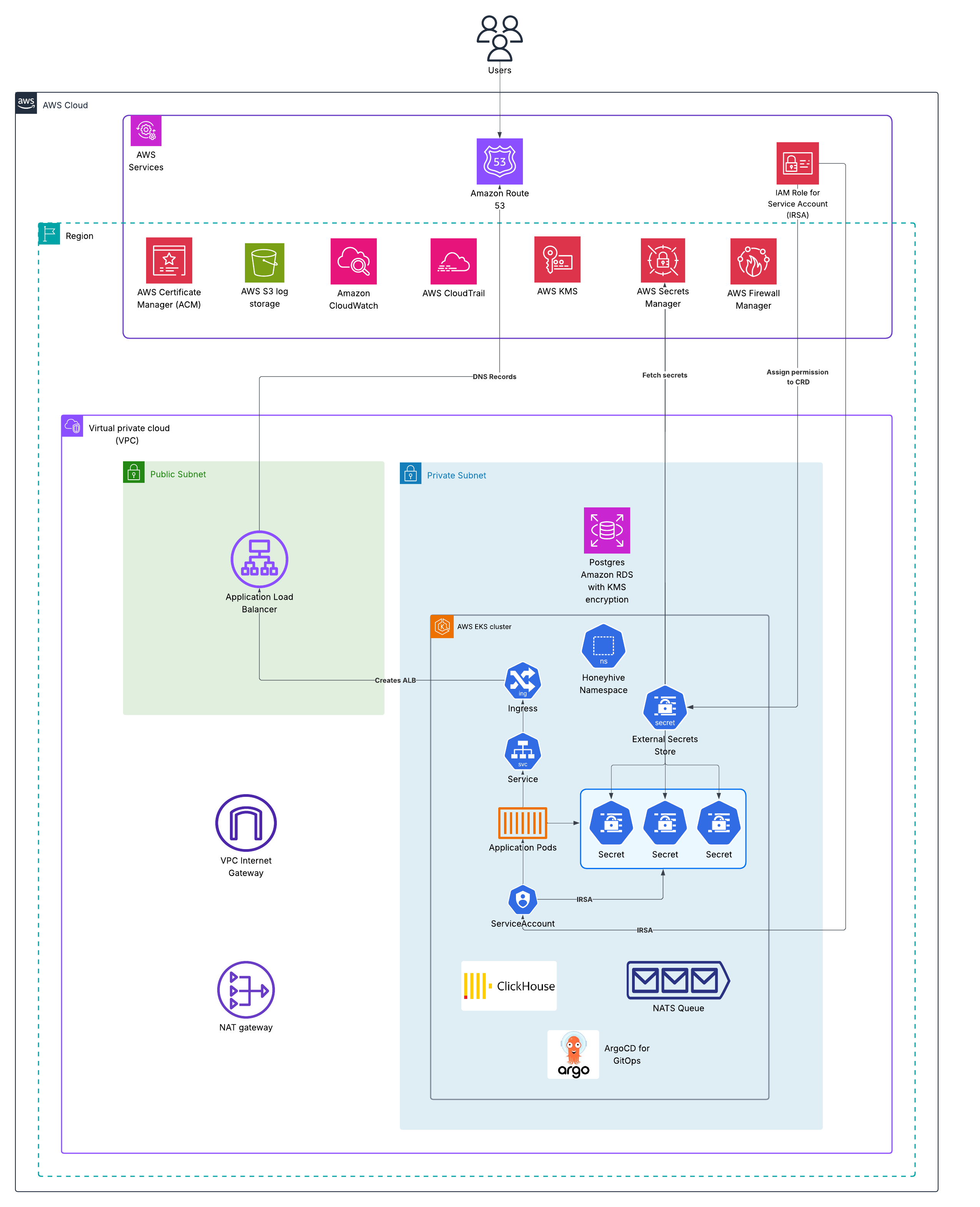 ### Infrastructure Overview
Our multi-tenant SaaS platform is hosted entirely within **AWS US-West-2**. Our dedicated SaaS version can be hosted in any AWS region worldwide.
#### Edge & Network Layer
* **Amazon Route 53**: Global DNS routing with health checks and failover capabilities
* **AWS Certificate Manager (ACM)**: Automated SSL/TLS certificate management for encrypted connections
* **Application Load Balancer (ALB)**: Distributes incoming traffic across availability zones with automatic scaling
* **VPC Architecture**: Isolated Virtual Private Cloud with segregated public and private subnets across multiple availability zones
#### Security & Access Control
* **AWS IAM Roles for Service Accounts (IRSA)**: Fine-grained permission management for Kubernetes pods without shared credentials
* **AWS Secrets Manager**: Centralized secrets management with automatic rotation
* **AWS KMS**: Customer-managed encryption keys for data-at-rest encryption
* **AWS Firewall Manager**: Centralized firewall rule management and DDoS protection
* **NAT Gateway**: Secure outbound internet access for private subnet resources
* **VPC Internet Gateway**: Controlled ingress for public-facing services
#### Compute & Orchestration
* **Amazon EKS (Elastic Kubernetes Service)**: Managed Kubernetes cluster with automatic updates and patches
* Multi-AZ deployment for high availability
* Auto-scaling groups for dynamic capacity management
* Pod security policies and network policies enforced
* AWS EKS cluster runs in private subnets with no direct internet exposure
#### Data Storage & Processing
* **PostgreSQL on Amazon RDS**:
* Metadata storage for projects, configurations, and user management
* Multi-AZ deployment with automatic failover
* Encrypted at rest using AWS KMS
* Automated backups with point-in-time recovery
* Read replicas for performance optimization
* **ClickHouse Instance**:
* High-performance columnar database for event storage
* Customer events are encrypted at rest
* Optimized for analytical queries on large datasets
* Data retention policies configurable per customer
* **Amazon S3**:
* Long-term log storage and archival
* Server-side encryption (SSE-KMS)
* Versioning enabled for audit trails
* Lifecycle policies for cost optimization
#### Monitoring & Observability
* **Amazon CloudWatch**: Real-time monitoring, logging, and alerting
* **AWS CloudTrail**: Comprehensive audit logging for all AWS API calls
* **ArgoCD for GitOps**: Infrastructure-as-code with automated deployments and rollbacks
#### Message Queue
* **NATS**: High-performance message queue for asynchronous processing
* TLS encryption for data in transit
* At-least-once delivery guarantees
* Isolated queues per tenant for data segregation
## Data Flow Architecture
### Infrastructure Overview
Our multi-tenant SaaS platform is hosted entirely within **AWS US-West-2**. Our dedicated SaaS version can be hosted in any AWS region worldwide.
#### Edge & Network Layer
* **Amazon Route 53**: Global DNS routing with health checks and failover capabilities
* **AWS Certificate Manager (ACM)**: Automated SSL/TLS certificate management for encrypted connections
* **Application Load Balancer (ALB)**: Distributes incoming traffic across availability zones with automatic scaling
* **VPC Architecture**: Isolated Virtual Private Cloud with segregated public and private subnets across multiple availability zones
#### Security & Access Control
* **AWS IAM Roles for Service Accounts (IRSA)**: Fine-grained permission management for Kubernetes pods without shared credentials
* **AWS Secrets Manager**: Centralized secrets management with automatic rotation
* **AWS KMS**: Customer-managed encryption keys for data-at-rest encryption
* **AWS Firewall Manager**: Centralized firewall rule management and DDoS protection
* **NAT Gateway**: Secure outbound internet access for private subnet resources
* **VPC Internet Gateway**: Controlled ingress for public-facing services
#### Compute & Orchestration
* **Amazon EKS (Elastic Kubernetes Service)**: Managed Kubernetes cluster with automatic updates and patches
* Multi-AZ deployment for high availability
* Auto-scaling groups for dynamic capacity management
* Pod security policies and network policies enforced
* AWS EKS cluster runs in private subnets with no direct internet exposure
#### Data Storage & Processing
* **PostgreSQL on Amazon RDS**:
* Metadata storage for projects, configurations, and user management
* Multi-AZ deployment with automatic failover
* Encrypted at rest using AWS KMS
* Automated backups with point-in-time recovery
* Read replicas for performance optimization
* **ClickHouse Instance**:
* High-performance columnar database for event storage
* Customer events are encrypted at rest
* Optimized for analytical queries on large datasets
* Data retention policies configurable per customer
* **Amazon S3**:
* Long-term log storage and archival
* Server-side encryption (SSE-KMS)
* Versioning enabled for audit trails
* Lifecycle policies for cost optimization
#### Monitoring & Observability
* **Amazon CloudWatch**: Real-time monitoring, logging, and alerting
* **AWS CloudTrail**: Comprehensive audit logging for all AWS API calls
* **ArgoCD for GitOps**: Infrastructure-as-code with automated deployments and rollbacks
#### Message Queue
* **NATS**: High-performance message queue for asynchronous processing
* TLS encryption for data in transit
* At-least-once delivery guarantees
* Isolated queues per tenant for data segregation
## Data Flow Architecture
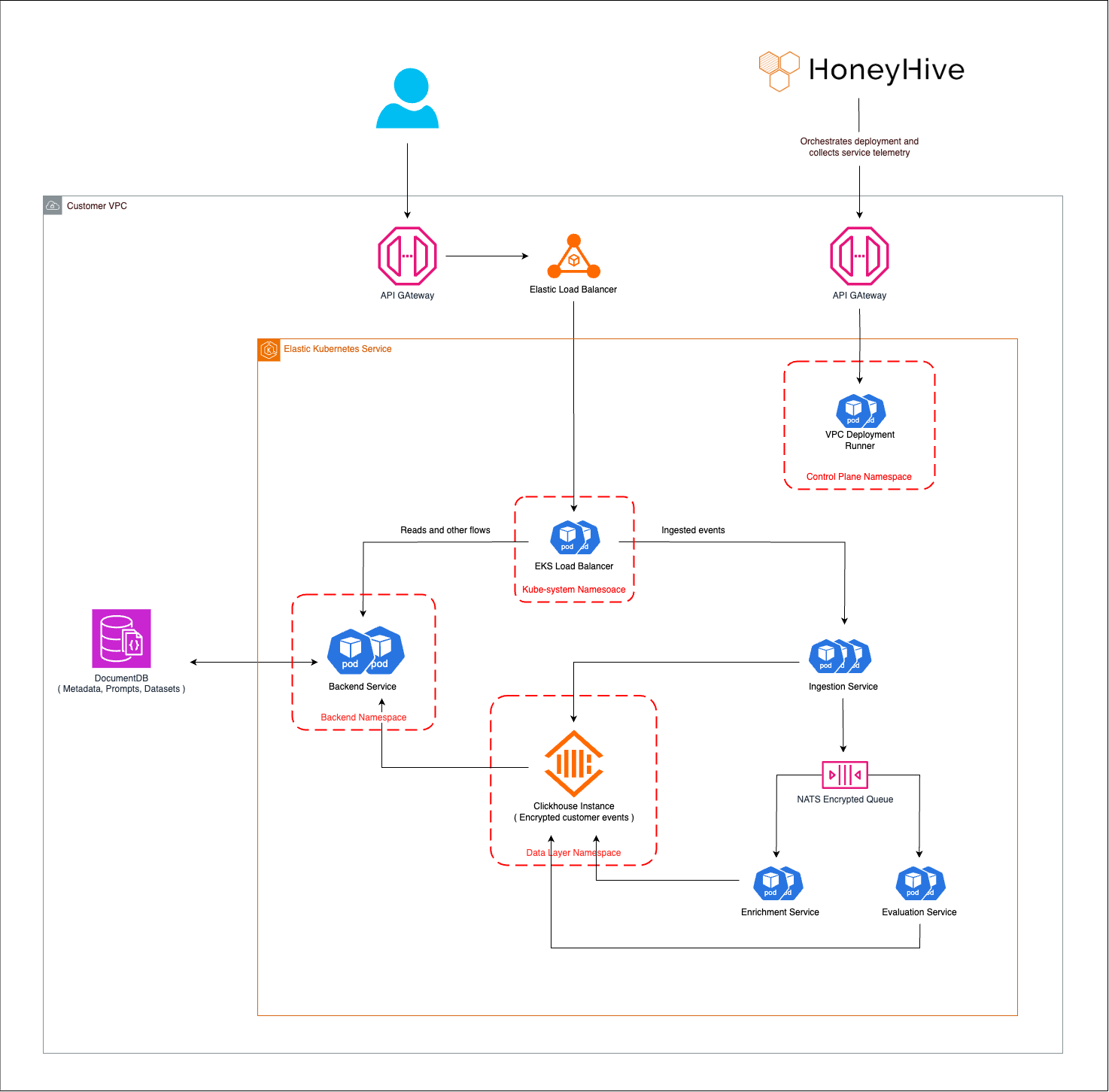 ### Request Flow
1. **API Gateway Layer**
* User requests enter through API Gateway with authentication and rate limiting
* Elastic Load Balancer distributes traffic across multiple availability zones
* TLS 1.2+ encryption enforced for all connections
2. **Kubernetes Service Mesh**
* **EKS Load Balancer** (Kube-system Namespace): Internal load balancing within the cluster
* **VPC Deployment Runner** (Control Plane Namespace): Orchestrates deployment and service discovery
3. **Backend Services** (Backend Namespace)
* **Backend Service**: Handles API requests, authentication, and authorization
* Connects to PostgreSQL RDS for metadata operations (prompts, datasets, configurations)
* Implements tenant isolation at the application layer
### Event Processing Pipeline
The event processing pipeline is designed for high throughput, low latency, and zero data loss:
1. **Ingestion Service**
* Receives events from customer applications via SDK or API
* Validates and normalizes incoming events
* Publishes to NATS Encrypted Queue for downstream processing
* Immediately acknowledges receipt to minimize client latency
2. **ClickHouse Data Layer** (Data Layer Namespace)
* Stores encrypted customer events with tenant isolation
* Optimized for high-volume writes and analytical queries
* Data encrypted at rest with customer-managed keys
3. **Enrichment Service**
* Consumes events from NATS queue
* Performs real-time enrichment (session inheritance, metric calculations)
* Updates event records with computed metadata
* Triggers online evaluators if configured
4. **Evaluation Service**
* Processes offline evaluation jobs
* Consumes from NATS Encrypted Queue
* Executes customer-defined evaluators (Python, LLM-based, or custom)
* Stores evaluation results back to ClickHouse
### Data Storage
* **PostgreSQL RDS**: Stores metadata including:
* User accounts and permissions
* Project configurations
* Prompt templates and versions
* Dataset definitions
* Evaluator configurations
* **ClickHouse**: Stores telemetry data as **wide events**, including:
* Traces and spans
* Event logs
* Evaluation scores
* Aggregated metrics
* Metadata and custom properties
## Security & Compliance
### Data Encryption
* **At Rest**: All data encrypted using AWS KMS with customer-managed keys
* **In Transit**: TLS 1.2+ for all network communications
* **Application Layer**: Additional encryption for sensitive customer data
### Network Security
* **VPC Isolation**: Customer VPC with private subnets for all data processing
* **Security Groups**: Strict ingress/egress rules limiting access to required ports only
* **Network Policies**: Kubernetes network policies enforce pod-to-pod communication restrictions
* **AWS PrivateLink**: Available for dedicated SaaS customers to establish private connectivity between your VPC and HoneyHive's services without exposing traffic to the public internet
* **External Secrets Store**: Separates secrets from application code
### Access Control
* **IAM Roles**: Service accounts use temporary credentials via IRSA
* **RBAC**: Kubernetes Role-Based Access Control for service permissions
* **Least Privilege**: Each service has minimal required permissions
* **Multi-Factor Authentication**: Available for all user accounts
### Compliance
* **SOC 2 Type II**: Audited annually
* **GDPR**: Data residency and privacy controls
* **HIPAA**: Available for healthcare customers
## Reliability & Performance
### High Availability
* **Multi-AZ Deployment**: Services distributed across multiple availability zones
* **Automatic Failover**: Database and compute resources automatically failover on failure
* **Health Checks**: Continuous monitoring with automatic recovery
* **Zero-Downtime Deployments**: Rolling updates with canary deployments
### Scalability
* **Horizontal Auto-Scaling**: Kubernetes HPA scales pods based on CPU/memory utilization
* **Vertical Scaling**: Database and storage scale independently
* **Queue-Based Architecture**: NATS queue buffers traffic spikes
### Request Flow
1. **API Gateway Layer**
* User requests enter through API Gateway with authentication and rate limiting
* Elastic Load Balancer distributes traffic across multiple availability zones
* TLS 1.2+ encryption enforced for all connections
2. **Kubernetes Service Mesh**
* **EKS Load Balancer** (Kube-system Namespace): Internal load balancing within the cluster
* **VPC Deployment Runner** (Control Plane Namespace): Orchestrates deployment and service discovery
3. **Backend Services** (Backend Namespace)
* **Backend Service**: Handles API requests, authentication, and authorization
* Connects to PostgreSQL RDS for metadata operations (prompts, datasets, configurations)
* Implements tenant isolation at the application layer
### Event Processing Pipeline
The event processing pipeline is designed for high throughput, low latency, and zero data loss:
1. **Ingestion Service**
* Receives events from customer applications via SDK or API
* Validates and normalizes incoming events
* Publishes to NATS Encrypted Queue for downstream processing
* Immediately acknowledges receipt to minimize client latency
2. **ClickHouse Data Layer** (Data Layer Namespace)
* Stores encrypted customer events with tenant isolation
* Optimized for high-volume writes and analytical queries
* Data encrypted at rest with customer-managed keys
3. **Enrichment Service**
* Consumes events from NATS queue
* Performs real-time enrichment (session inheritance, metric calculations)
* Updates event records with computed metadata
* Triggers online evaluators if configured
4. **Evaluation Service**
* Processes offline evaluation jobs
* Consumes from NATS Encrypted Queue
* Executes customer-defined evaluators (Python, LLM-based, or custom)
* Stores evaluation results back to ClickHouse
### Data Storage
* **PostgreSQL RDS**: Stores metadata including:
* User accounts and permissions
* Project configurations
* Prompt templates and versions
* Dataset definitions
* Evaluator configurations
* **ClickHouse**: Stores telemetry data as **wide events**, including:
* Traces and spans
* Event logs
* Evaluation scores
* Aggregated metrics
* Metadata and custom properties
## Security & Compliance
### Data Encryption
* **At Rest**: All data encrypted using AWS KMS with customer-managed keys
* **In Transit**: TLS 1.2+ for all network communications
* **Application Layer**: Additional encryption for sensitive customer data
### Network Security
* **VPC Isolation**: Customer VPC with private subnets for all data processing
* **Security Groups**: Strict ingress/egress rules limiting access to required ports only
* **Network Policies**: Kubernetes network policies enforce pod-to-pod communication restrictions
* **AWS PrivateLink**: Available for dedicated SaaS customers to establish private connectivity between your VPC and HoneyHive's services without exposing traffic to the public internet
* **External Secrets Store**: Separates secrets from application code
### Access Control
* **IAM Roles**: Service accounts use temporary credentials via IRSA
* **RBAC**: Kubernetes Role-Based Access Control for service permissions
* **Least Privilege**: Each service has minimal required permissions
* **Multi-Factor Authentication**: Available for all user accounts
### Compliance
* **SOC 2 Type II**: Audited annually
* **GDPR**: Data residency and privacy controls
* **HIPAA**: Available for healthcare customers
## Reliability & Performance
### High Availability
* **Multi-AZ Deployment**: Services distributed across multiple availability zones
* **Automatic Failover**: Database and compute resources automatically failover on failure
* **Health Checks**: Continuous monitoring with automatic recovery
* **Zero-Downtime Deployments**: Rolling updates with canary deployments
### Scalability
* **Horizontal Auto-Scaling**: Kubernetes HPA scales pods based on CPU/memory utilization
* **Vertical Scaling**: Database and storage scale independently
* **Queue-Based Architecture**: NATS queue buffers traffic spikes